Biotrade
Biotrade relates to the production and trade of products and ingredients from local ecosystems. When it follows strict conditions of ethics and sustainability, it is an important tool to reconciliate economy and biodiversity.
More on the challenges of biodiversity here.
Context
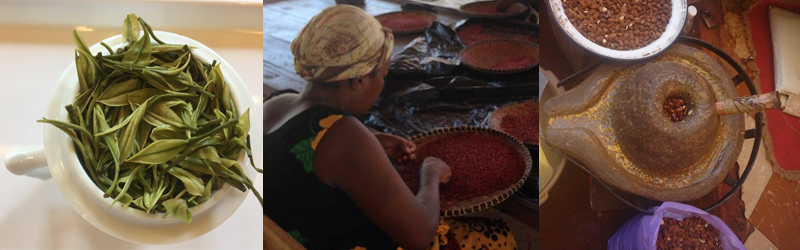
Biodiversity produces extremely diverse and valuable resources for human beings: food, health, energy, beauty, pleasure. These resources are often fragile. When managed with respect for ecosystems, work and traditional knowledge, they are levers for human well-being, protect biodiversity and the well-being of local rural people.
Tea, cocoa, coffee, aromatic and medicinal plants, spices and cosmetic ingredients are fragile resources appreciated by everybody.
Our approach
- a classical market approach (market research, monitoring and quality control, business plans, etc.);
- the principles of fair trade (fair and equitable payments, préparation to certification when desireable);
- compliance studies, specifically on the Nagoya Protocol on Access to Genetic Resources and the Fair and Equitable Sharing of Benefits Arising from their Utilization;
- the principles of an ecological economy (ecosystem review, accounting for externalities)
This approach allows to express the full potential of local know-how and ecosystems and agrosystems, creating value chains and brands of excellence, valued at their fair prices on national and international markets.
Our services
- Development of natural products: market study, quality control, business plans, capacity building.
- Ethics and sustainability: social responsibility, fair trade, organic agriculture, access and benefit sharing, certification.
- Legal advice: Convention on Biological Diversity and Nagoya protocol, regulation of imports in the European Union.
Our experience
- Ten years of expérience as a Fair Trade project manager for producers organizations and as a facilitator of an international community of practice on Fair Trade. Associate member of the World Fair Trade Organization.
- Twelve years of experience as a consultant for international cooperation agencies (UNDP, UNIDO, GIZ…) and for companies(cosmetics, ethical funds, etc.) in Latin America, Africa and South-East Asia.
- Expert of the Nagoya Protocol on Access to Genetic Resources and the Fair and Equitable Sharing of Benefits Arising from their Utilization, 10 studies conducted.
- Specialist in ecological economics, expert on access and benefit sharing of biodiversity and traditional knowledge.
- By sector: coffee (Latin America, East Africa), cocoa (Madagascar, West Africa), tea (China and Vietnam), cosmetic ingredients (Latin America, Africa), handicrafts and textiles (global).
Pierre worked as an expert for GIZ Nepal to support the herbal companies from Nepal to have business meetings with relevant importing companies of Europe. He was very dedicated and proactive in his approach which was well appreciated by the Nepali delegation. I wish him all the best for his future endeavors.
Commerce équitable : un nouveau label avec des conditions renforcées pour les producteurs
En 2015, un nouveau label de commerce équitable a vu le jour en France, le Symbole des Producteurs Paysans (SPP). Quelles sont les caractéristiques de cette nouvelle certification, et pourquoi vient-elle enrichir le panorama de la certification équitable ? Un besoin...
Biodiversity and Trade: The Nagoya Protocol entered in force on Oct 12, 2014
Ratification by Uruguay (above) allowed the Nagoya Protocol on access to genetic resources and equitable sharing of its benefits to enter in force on October 12th, 2014, that is 90 days after the reception of this 50th ratification. This date is the day before the...
Collections du Muséum National d’Histoire Naturelle : quelles règles pour le partage des avantages ?
Jean-Dominique Wahiche est directeur des Collections au Muséum National d'Histoire Naturelle, une des plus importante institutions mondiales consacrées à la recherche et à la diffusion du savoir naturaliste. Ces collections regroupent près de 62 millions d'articles...
3 approaches to conciliate economy and ecology
Can the economy be reconciled with the environment? These ways of understanding reality seem so remote that reconciliation appears as complex or impossible for many people. Yet steps to reconcile economic activity to the logic of life exist. I invite you to discover...
5 findings on the development of argan oil supply chains
From April 30 to May 2, 2012, Pierre Johnson and Eugénie Malandain went on an exploratory mission in the region of the argan forest near Agadir (Morocco). Pierre Johnson participated in the roundtable organized in partnership with Rencontres Solidaires...
Tar sands: a major obstacle for the great transition
Despite an activist victory to avoid the construction of the Keystone XL pipeline over a sensitive area, oil from Alberta State in Canada is still likely to flow through North America. More important than the route to refineries in Texas is the origin of the oil: tar...
Pierre W. Johnson
International consultant, study and sustainable development of natural products value chains. Specialist of markets of origin, quality and high value products. Expert on Access and Benefit Sharing.
Keynote speaker on transition to an ecological economy & society.
Member of the
International Value Links Association.
Associate expert to Tero.